
PUBLICATION | Change The Story report
Earth Hour: New report explores the local carbon market in Kenya
The report has been released by the Kenya Private Sector Alliance (KEPSA) through its Knowledge
Center, the Sustainable Inclusive Business Kenya
24th March 2023, Nairobi:
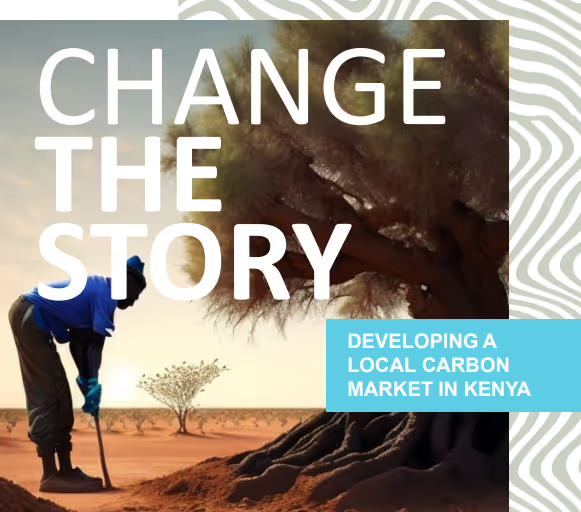
Through the Sustainable Inclusive Business (SIB-Kenya), the Kenya Private Sector Alliance (KEPSA) has released a report dubbed “Change the Story: Developing a Local Carbon Market in Kenya”. The report describes the current situation, reflects on the opportunities for a Kenyan carbon market, and comes just ahead of the Earth Hour celebrations on Saturday the 25th of March 2023 across the world.
Climate change and biodiversity are complex, global and interconnected issues. This report is limited to the role of the Kenyan private sector in the voluntary carbon market (VCM) with a focus on nature-based solutions (NBS) in addressing global warming, biodiversity loss and deforestation. It is part of the Change the Story project by SIB-Kenya which focuses on NBS because of the extra benefits they provide to the conservation of biodiversity, the protection of landscapes, and community development.
The global market of carbon credits is booming, with an estimated turnover of US$2 billion in 2021,and a prediction of 10-40 US$ billion in 2030 according to Shell and BCG. Closer home, Kenya ranks number 8 on the list of countries selling carbon credits from Nature-Based Solutions, according to the Voluntary Carbon Market overview 2022 by ClimateFocus. At the Kenya Carbon Market Roundtable held in January 2023, KEPSA noted that Kenya has the potential to sequester, reduce, or avoid ~30 Mt CO2e/yr (metric tons of carbon dioxide equivalent per year); mobilize up to $600 million annually from regulatory compliance and voluntary carbon market (VCM) projects by 2030 using an average price of $20 per ton.
From 2016 to 2021, Kenya issued ~26 MtCO2e of carbon offsets, more than any other African country and approximately 20 per cent of total African credits. “We’re encouraged that the government, the private sector led by KEPSA, and a wide array of the conservancy, agricultural and reforestation organizations are all eager to regreen Kenya and fight imminent threats associated with global warming, like drought, loss of biodiversity and failing harvests,” said Ebenezer Amadi, the Program Manager at SIB-Kenya, adding that an effort to streamline the domestic carbon market alongside the ongoing export of carbon credits is a worthwhile and timely course. The report shows massive potential for carbon sequestration, with growing global demand. However, the export-focused policy in Kenya leaves Kenyan companies in the dark about domestic offsetting options. Notwithstanding the ongoing debate about the benefits of the growing market for carbon credits, Kenya has virtually no legal framework that would restrict credits to be issued or bought, no taxation of credits nor the introduction of a mandatory carbon emissions market. Alternatively, the government has been noted to be strongly in favour of an active role of the private sector in reforestation and afforestation initiatives. “New suppliers are struggling to access the market because they are unsure how to approach buyers and have little experience with auditing their projects. On the demand side, we only found scattered examples of Kenyan companies purchasing carbon credits. That would explain why most Kenyan companies often set targets in terms of the number of trees planted or square km covered rather than in tons of CO2 sequestered,” highlights Jos Reinhoudt, author of the report, and a Sustainability Consultant.
Quoting the Safaricom Annual report, 2022 (page 133), “The remaining 26% of our carbon emissions will be offset through our reforestation programme. We have committed to growing five million trees in degraded public forests in five years and have to date planted over one million trees in Kieni forest, South Marmarnet, Nandi South, Kakamega and Port Reitz.” This approach has been reinforced by Valentine Cheruiyot, Manager-Climate and Environmental Management at Safaricom, who confirms that the company pledges to plant 1 million trees a year. For 75 KES per tree, it would cost the company 75M KES or US$600,000 to offset their 2021 carbon footprint of 66,032 tCO2. This indicates a price of US$ 9.09 per ton of CO2. The report points to Safaricom as a good practice in Kenya, not only due to its transparency about its carbon footprint but also for its commitment to Science-Based Targets for the climate.
The government is using the same methodology to stress the importance of carbon capturing with nature-based solutions, evidenced by the tree restoration program at Ngong Hills Forest to combat the effects of climate change in the country. The initiative aims to plant 15 billion trees by 2032, towards reducing greenhouse gas emissions, stop and reverse deforestation, and restore 5.1 million hectares of deforested and degraded landscapes through the African Landscape Restoration Initiative.
As the world dedicates an hour to earth, this report is a call to action for the private sector especially, to actively play their part in tackling climate change, by among others incorporating offsetting in their corporate carbon strategy, to compensate for greenhouse gas (GHG) emissions that cannot (yet) be avoided. On Sat, Mar 25, 2023, 8:30 PM – 9:30 PM, as we switch off and give an hour for the earth, let us individually or collectively, do something positive to make the planet a better place.
About KEPSA
The Kenya Private Sector Alliance (KEPSA) is the apex body of the private sector in Kenya. KEPSA brings together local and foreign business associations, chambers of commerce, professional bodies, corporates as multinational companies, medium, corporates, SMEs, and start-ups from all sectors of the economy in the country, representing over 1,000,000 million businesses under one umbrella to enable them to speak with one voice when engaging Government, development partners and other stakeholders on cross-cutting policy issues affecting private sector development and implements programs that ensure the growth of business and social – economic development of the country. KEPSA supports businesses with opportunities for training, networking, financial linkages, mentorships & coaching, access to markets, value
chains, and investment opportunities with many partners worldwide. The corporate members are also based in all parts of the country or have offices or branches.
About Sustainable Inclusive Business
Sustainable Inclusive Business – Kenya (SIB-K) is a knowledge centre under the Kenya Private Sector Alliance (KEPSA) funded by the Netherlands Government. The project aims to encourage businesses to be sustainable and inclusive, positively impacting People, Planet, and Profit. This is achieved through sharing information on best practices and viable, sustainable business models, implementing sustainable business policies, and creating partnerships. SIB-K is also the lead organization implementing the Kenya Plastics Pact. This ambitious, collaborative initiative is bringing together stakeholders across the whole plastics value chain to transform the current linear plastics system into a circular economy for plastics. All stakeholders sign up for a joint set of ambitious and time-bound targets, ensuring that this collaboration will drive significant change by 2030.
About TheRockGroup
We believe that fair and sustainable business can and should accelerate the transition towards a sustainable economy and society. TheRockGroup works on different levels, each focussed on offering tailor-made services to help different stakeholders take a proactive role in this transition.
About the author: Jos Reinhoudt
Jos Reinhoudt is a seasoned sustainability expert focused on actionable business strategies to create a climate-neutral, circular and inclusive economy. Passionate about East Africa, biodiversity, and innovation. In 2020 and 2021 he worked with SIB Kenya on the Single-Use Plastic Ban and Circular Agriculture . He runs an independent consultancy, Duurzame Denkkracht, and also works for MVO Nederland , the largest European corporate network for sustainability. Contact: https://www.linkedin.com/in/josreinhoudt/ or jos@reinhoudt.com .
For Press Inquiries, Please Contact:
Josephine Wawira – Communications Lead, Sustainable Inclusive Business
josephine@sustainableinclusivebusiness.org
.png)