
Springtij Forum 2018
Theme Mobility & Transport – Our Reflection with Summary and Outcomes
Facilitators: Elfrieke van Galen & Pam van de Klundert
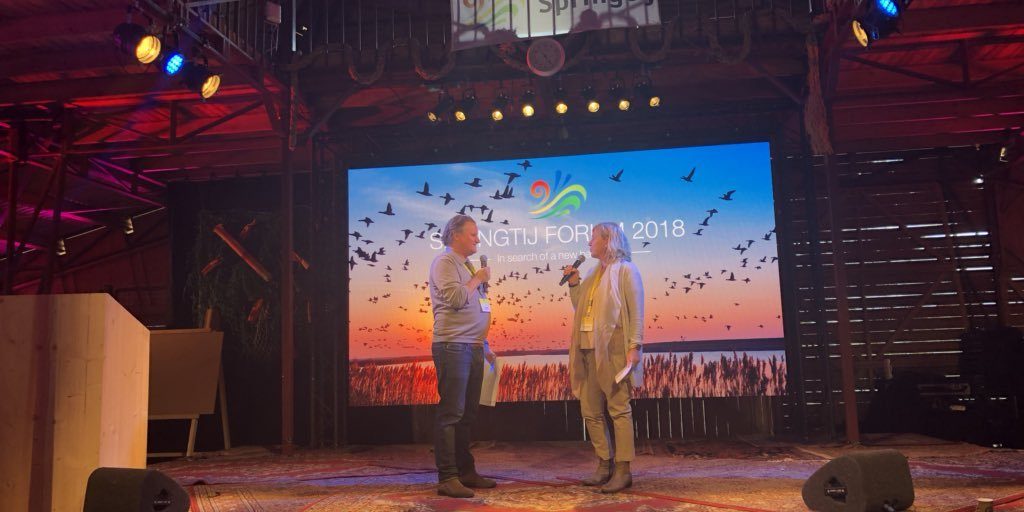
The 9th edition of the three-day sustainability forum Springtij on Terschelling welcomed over 800 participants, hosted 70 workshops, and featured national and international speakers. The programme covered a wide range of themes, including climate adaptation, the energy transition, the role of nature, the circular economy, food, oceans, and sustainable mobility and transport. Participants contributed knowledge and experience from a wide variety of backgrounds. The natural landscape of Terschelling formed a beautiful backdrop for Springtij.
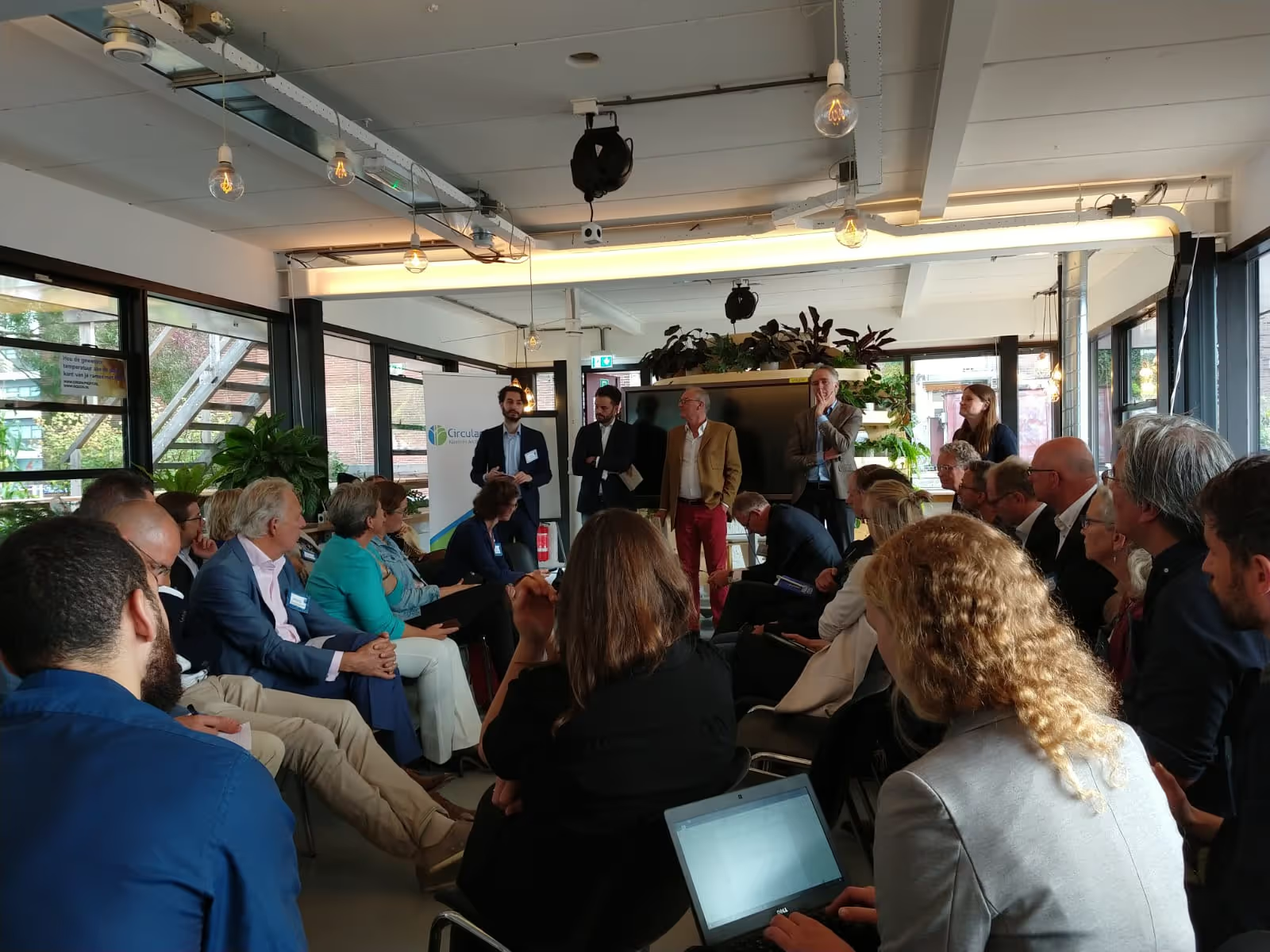
Mobility & transport was the central theme of four sessions, which were substantively designed by The Rock Group.
- Session 1: How are organisations within mobility and infrastructure preparing for the expected climate conditions of 2050?
- Session 2: Why has the impact of freight transport remained underexposed, and who should take responsibility?
- Session 3: What dynamics exist between employers and employees, and how can and should sustainability be embedded in this relationship?
- Session 4: What role can and should CO₂ compensation play in reducing emissions from mobility and transport, and how can we design a future-proof system?
Our society is becoming increasingly urbanised. By 2030, an estimated 60% of the world’s population will live in urban areas. Mobility and transport are essential conditions in this process of urbanisation. Globalisation means that goods are assembled from materials and resources sourced from all over the world and subsequently transported across the globe. The demand for mobility and transport is growing exponentially, while its negative impacts are exceeding acceptable limits. System-level adaptation is therefore necessary.
At Springtij, this need for adaptation takes centre stage. The National Adaptation Strategy (NAS) outlines numerous impacts of climate change for which adaptation is required.
The impact of mobility and transport is approaching the limits of what we find acceptable. System-level adaptation is essential. Within the mobility and transport theme at Springtij 2018, an exploration took place of the different frameworks within which change is needed, the perspectives that exist within these frameworks, and how they can be positioned in light of long-term goals and progress.
What does more extreme weather mean for transport & mobility?
In the first session, together with Carola Wijdoogen (NS), climate expert Ian Dunlop, and Marc Bras (BMWi), the group examined the consequences of more frequent and extreme weather events and their effects on infrastructure and its users. The National Adaptation Strategy maps the effects of climate change on our living environment and proposes an approach for action. This report served as the starting point for the rail sector to jointly take up the challenge. Together, they began mapping impacts and potential climate adaptation strategies.
Other sectors appear not yet to have translated the NAS conclusions into action. This session explored the choices that will need to be made in the coming years to minimise the effects of climate change. The conclusion was that a balance must be found regarding acceptable costs to make the mobility and transport sector climate-resilient. Because climate change is not directly visible to infrastructure users, it is important to translate its impacts into local initiatives. In addition, infrastructure users must be, or be made, aware of their choices regarding sustainable travel.
CO₂ emissions from international shipping: the great unknown
The second session focused on CO₂ emissions from international shipping. The Port of Rotterdam provided insight into emissions from sea vessels calling at Rotterdam compared to emissions from companies operating within the port area. Many Springtij participants had not realised that it is ultimately companies (and, behind them, consumers) that initiate global freight transport. At the same time, companies can take measures themselves to reduce emissions from their transport and logistics. For example, GoodFuels shared that Tony’s Chocolonely, as the first brand, has made its sea freight CO₂-neutral by using biofuels.
Employee CO₂ emissions not part of labour conditions negotiations
Reducing CO₂ emissions from commuting and business travel is the goal of the coalition “Anders Reizen” (“Travelling Differently”). Through a range of measures, the 40 participating companies have demonstrably reduced their CO₂ footprint. Many of these measures are voluntary, the proverbial carrot, encouraging employees to travel differently.
Should CO₂ emissions become part of labour conditions negotiations? Is it a component of salary? Can employers compel employees to change their travel behaviour? Participants discussed these questions with works council members, Hans de Boer (VNO-NCW), and Willem Jelle Berg (CNV). The shared conclusion was that employee CO₂ emissions do not belong in the domain of labour conditions. However, companies should anchor sustainable mobility at board level and should more actively, together with neighbouring companies, stimulate demand for better public transport.
CO₂ compensation, a necessity?
Continuous pressure to reduce CO₂ emissions is a given in aviation, where fuel accounts for around 30% of costs. However, aviation free from fossil fuels is still far off, and biofuels remain limited in availability. In the short term, CO₂ compensation is the method used by aviation to reduce emissions by investing in sustainable projects elsewhere.
This session showed that CO₂ compensation is a complex topic for participants. ANVR shared positive experiences with CO₂-inclusive travel packages offered by several tour operators. The Green Deal “National Carbon Market” announced that voluntary compensation projects on Dutch soil such as peat meadow restoration and geothermal energy will soon become available.
Shadow table on mobility
The discussion on the climate agreement was revisited during Springtij in so-called shadow tables, including one on mobility and transport. Viewing mobility as a means rather than an end, recommendations were formulated for the official mobility table. Among other inputs, experiences from the Elfwegentocht were used — an initiative by students and pupils in Friesland to travel for two weeks without fossil fuels. Under the slogan “two weeks of celebration without a drop of petrol”, as many people as possible travelled using sustainable modes of transport.
Infrastructure and public transport should increasingly be used as pull strategies to achieve broader goals, such as encouraging the spread of housing from the Randstad to faster and better-connected rural areas. In addition, integrating sustainable mobility facilities at building, street, and neighbourhood levels should become a standard component of developing new living environments, just as sewer systems are today.
Another area with significant potential lies in combining passenger transport with parcel delivery. All such new initiatives should focus on reducing CO₂ emissions and creating cleaner, smarter living environments.
All recommendations from the shadow table were subsequently presented to the official climate table on mobility and transport.